
Originally published by Michael Read of The Australian Financial Review
22.07.2026
Australia is heading for its weakest decade of living standards growth in more than a century, fuelling support for One Nation and prompting former Reserve Bank governor Philip Lowe to warn that fundamental policy change is needed to encourage business investment.
GDP per person has risen by just 4 per cent so far this decade, putting the 2020s on track to be the weakest period for living standards since the 1910s, after years of stagnant productivity were compounded by the COVID-19 pandemic, the energy crisis triggered by Russia’s invasion of Ukraine and high inflation.
The grim milestone comes after a string of reports this month showing Australia has become an international laggard on inflation and wages, underscoring the scale of the economy’s productivity problem. The OECD revealed in early July that Australian real wages had fallen 5 per cent over the past five years – one of the worst results among the organisation’s 38 member countries.
Lowe on Tuesday said the ongoing stagnation in living standards was sobering, and he was not optimistic the situation would improve.
“Our living standards have stagnated, there has been no net growth in per capita incomes for seven or eight years – that’s after per capita income rising 1.5 per cent a year for nearly three decades. This is the fundamental economic problem the country faces,” Lowe said, after releasing draft governance rules for the Australian Securities Exchange.
The grim milestone comes after a string of reports this month showing Australia has become an international laggard on inflation and wages, underscoring the scale of the economy’s productivity problem. The OECD revealed in early July that Australian real wages had fallen 5 per cent over the past five years – one of the worst results among the organisation’s 38 member countries.
Lowe on Tuesday said the ongoing stagnation in living standards was sobering, and he was not optimistic the situation would improve.
“Our living standards have stagnated, there has been no net growth in per capita incomes for seven or eight years – that’s after per capita income rising 1.5 per cent a year for nearly three decades. This is the fundamental economic problem the country faces,” Lowe said, after releasing draft governance rules for the Australian Securities Exchange.
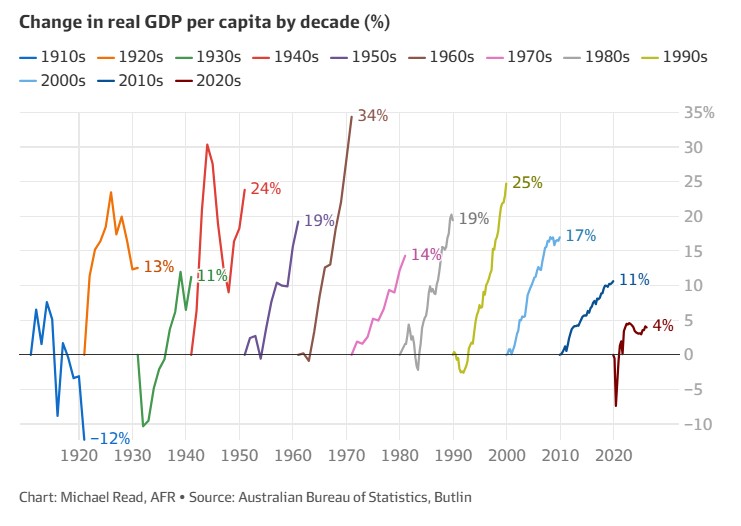
Worst standard of living rise since World War I
Official forecasts suggest further gains in GDP per capita in the coming years are unlikely to be significant. The RBA forecasts economic growth will slow from 2.5 per cent to 1.3 per cent by December, only marginally higher than its forecast for 1.2 per cent population growth this year.
The growth slowdown means the 2020s may be the worst decade for living standards since the 1910s, when GDP per capita plunged 12 per cent due to the economic dislocation caused by World War I, a severe drought from 1914 to 1915 that wiped out the wheat crop, and the arrival of the Spanish flu in 1919, which infected up to 40 per cent of the population.
The outcome would also represent a step-down from recent decades. GDP per capita grew by 25 per cent in the 1990s, before slowing to 17 per cent in the 2000s and 11 per cent in the 2010s, as the benefits of the Hawke, Keating and Howard governments’ tax and economic deregulation reforms gradually faded.
Redbridge director Tony Barry said challenging economic conditions had fuelled an entrenched pessimism about the future and was driving voters toward Pauline Hanson’s One Nation.
“For the One Nation voter, Pauline Hanson is their wrecking ball against the two-party system. They feel the current political model has failed them, and Hanson is their truth teller,” Barry said.
The latest The Australian Financial Review/Redbridge Group/Accent Research poll showed 90 per cent of One Nation voters thought Australia was heading in the wrong direction. In the January survey, 84 per cent of One Nation voters said they thought the Australian political system either needed major changes or to be “burned down” and started over.
“A really common theme in a lot of focus groups with respondents who self-report as experiencing pervasive cost of living pressures, is that they feel they aren’t really living, they’re just surviving,” Barry said.
A spokesman for Treasurer Jim Chalmers said the government recognised the “really substantial, long-held challenges Australia is confronting on productivity and the risks to growth as a result of increased uncertainty and volatility in the global economy”.
“The budget was designed to respond to these challenges, with a comprehensive package to boost productivity and reduce regulatory costs and grow Australia’s economy,” the spokesman said.
Deloitte Access Economics partner Pradeep Philip said the decline in GDP per capita growth had been a long time in the making.
“What that tells you is that the things that drove economic growth post-World War II are starting to peter out,” Philip said.
“This is true at a global level, it’s true at a national economic level, and it’s also true for a lot of industries. It’s why we’re in this period where there is this hunt for new sources of productivity and new sources of growth.”
Philip argued Australia’s productivity challenge will only be solved by fostering more young, innovative businesses that can commercialise new technologies, challenge incumbents and create the next wave of economic growth.
“The key to that, for any economy, is how you get more churn by new businesses starting, and then do things that allow them to survive longer,” Philip said.
“What you want is more of these businesses to start up, because they’re trying to solve problems that incumbents can’t.”
AMP chief economist Shane Oliver said poor productivity growth was the fundamental driver of the economy’s malaise, with figures from the Australian Bureau of Statistics showing labour productivity has barely grown since 2016.
Since the introduction of the GST in 2000, Oliver said there had been no big new reforms, while in other areas there had been backsliding: reregulation in industrial relations, urban congestion and high house prices caused by strong population growth, lacklustre business investment, increasing market concentration, and expansion in government spending and confusion over climate policies.
“The surge in public final demand – which is now running around 28 per cent of GDP compared to an average of around 22.6 per cent over the previous 40 years – is particularly significant, as the required shift in resources from the private sector to the public sector has been bad news for productivity,” Oliver said.
Oliver called for a broader GST and lower reliance on income tax, limits on government spending, deregulation to boost housing and labour market flexibility, stronger incentives for business investment, greater competition, migration aligned with housing supply, and more stable climate policy to lift productivity and living standards.
“In the absence of a crisis, it’s hard to see Australian governments undertaking the sort of hard-nosed economic rationalist reforms required,” Oliver said.
