
Originally published by Michael Read of The Australian Financial Review
25.05.2024
When inflation rises, governments fall – and Australia’s looks increasingly wobbly.
Each of the 10 governing parties in rich countries that went to the polls this year experienced a decline in their vote share – the first time this has happened in almost 120 years of records, according to analysis by John Burn-Murdoch at the Financial Times.
“Ultimately voters don’t distinguish between unpleasant things that their leaders and governments have direct control over and those that are international phenomena resulting from supply-side disruptions caused by a global pandemic or the warmongering of an ageing autocrat halfway across the world,” Burn-Murdoch said.
There is little reason to expect the Albanese government will buck the global trend at next year’s federal election. Indeed, polls suggest Labor is on track to be reduced to minority government.
What is underappreciated is just how poorly Australia has fared compared to almost every other rich country over the past couple of years on two of the issues that matter most to voters right now: cost of living and migration.
Let’s start with cost of living.
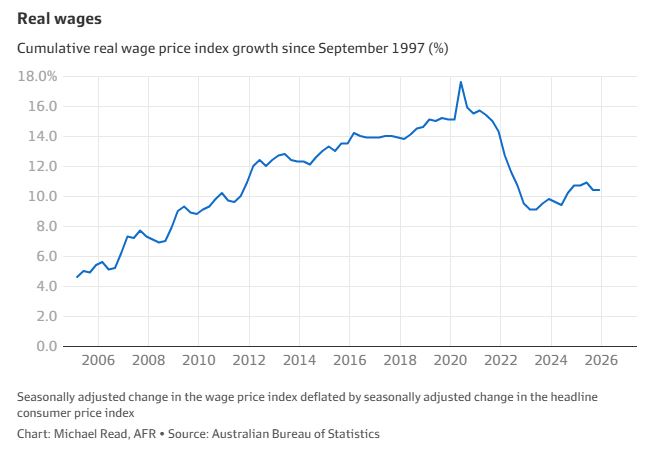
Since December 2019, consumer prices have risen 18.1 per cent, but wages have only grown by 14.5 per cent. As a result, “real” inflation-adjusted hourly wages are now about 4.5 per cent lower than they were before the pandemic, taking purchasing power back to 2011 levels. The bulk of the pain has occurred since late 2021 when inflation took off.
Only five advanced economies – Sweden, Czechia, Italy, New Zealand and Finland – have experienced a sharper decline in real hourly wages, according to the OECD’s annual Employment Outlook, released in July.
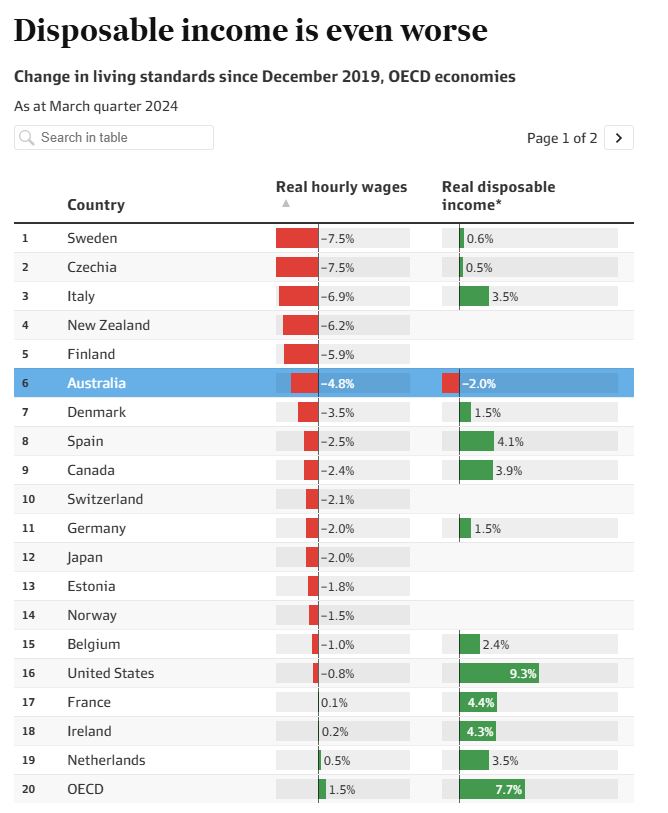
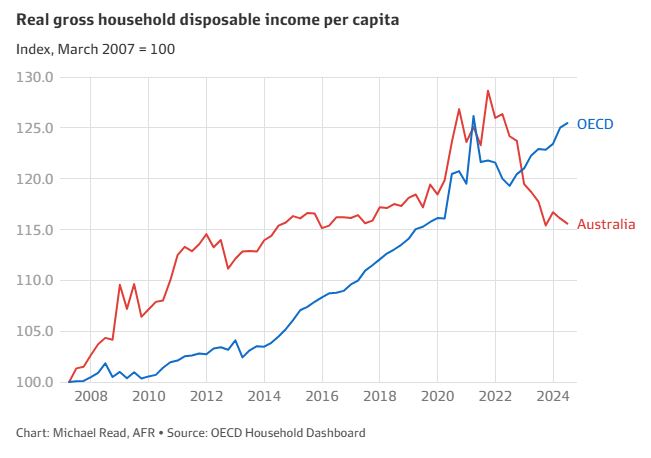
The picture gets even bleaker when we look beyond wages at real disposable income, which is a broader measure of living standards that accounts for how much of their wages households have left over after inflation, taxes and paying their mortgage.
On this measure, Australians have experienced the sharpest decline in purchasing power across measured OECD economies over the past few years. Disposable incomes are 2 per cent lower than pre-pandemic levels in Australia, but 7.7 per cent higher across the OECD.
Worryingly for Labor, voters overseas have turfed out governments that oversaw far milder cost-of-living crunches than the one Australians are experiencing right now, including in the United States and Britain.
Wages growth lags
So what explains the unlucky country’s dismal performance on the global cost-of-living leaderboard?
Interestingly, inflation has not been particularly high in Australia by global standards. The problem, rather, is that wages growth has been relatively weak. In fact, the pace of nominal wages growth in Australia was in the bottom quartile of OECD economies in March, despite the country boasting one of the strongest jobs markets in the developed world.
The OECD pointed to the dominance of collective bargaining as a potential driver of the poor wages outcomes in laggard economies like Australia.
About 61 per cent of Australian workers have the right to collectively bargain – almost double the OECD average and the highest of any English-speaking country – through multi-year enterprise bargaining agreements and awards.
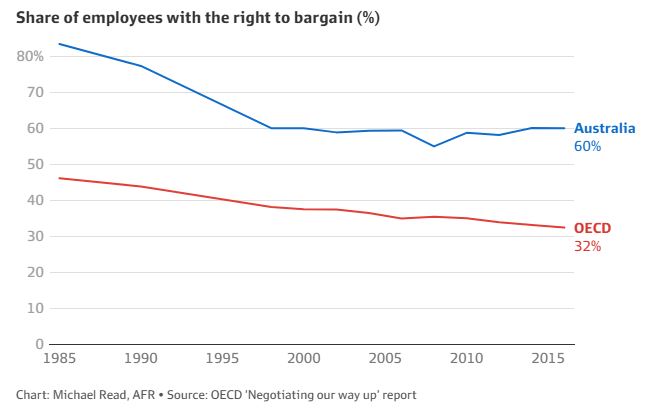
Because EBAs can lock in pre-agreed rates of pay for several years, wages outcomes in Australia tend to lag the economic cycle, unlike countries like the US and Britain where individual agreements dominate. Workers covered by collective agreements receive pay rises at staggered intervals, and deals are renegotiated infrequently.
Cashflow crunch
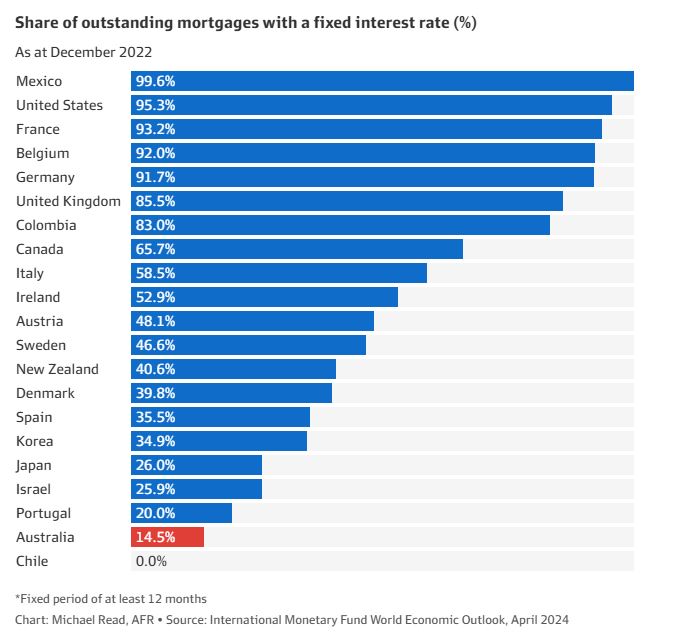
Disposable incomes have also taken a battering from rising interest rates. The IMF estimates that almost 85 per cent of Australian mortgages are priced at a variable interest rate, making Australians far more sensitive to changes in the cash rate than almost all of their advanced economy peers.
So even though the RBA has raised the cash rate by less than many other central banks, Australian borrowers have experienced a far bigger rise in average mortgage rates than almost any other advanced economy over the past couple of years, bar Norway. Scheduled mortgage payments consumed a record one in 10 dollars of household income in June, the RBA estimates.
Compounding voters’ cashflow woes is the stealth tax of bracket creep.
Australia is among the cohort of 21 OECD countries that do not index their tax brackets for inflation or wages growth. That means when a worker receives a pay rise, their average income tax rate increases.
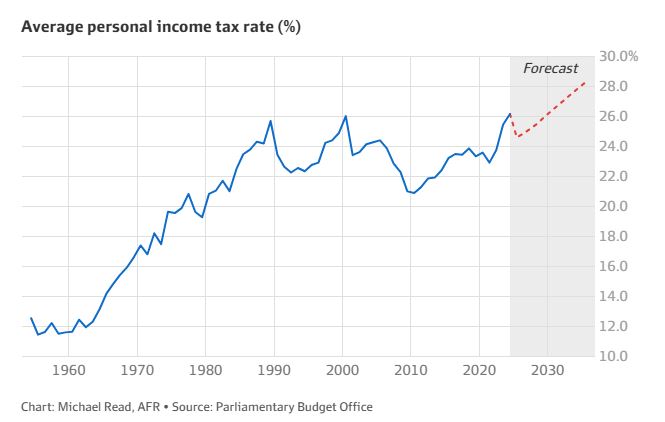
That dynamic helped propel the average personal income tax rate to a record 26.1 per cent last financial year, according to the Parliamentary Budget Office.
While the stage three tax cuts on July 1 have returned some bracket creep to voters, the decline has only taken income tax rates back to 2022 levels. Polls suggest voters have not thanked Labor for the modest lift in their take-home pay.
Migration booms
On the other issue frequently cited as a decisive factor in recent elections – migration – Labor again has a tough story to tell.
Net overseas migration hit record levels last year across a swath of rich countries including Australia, fuelling community backlash against the perceived strain on infrastructure and housing.
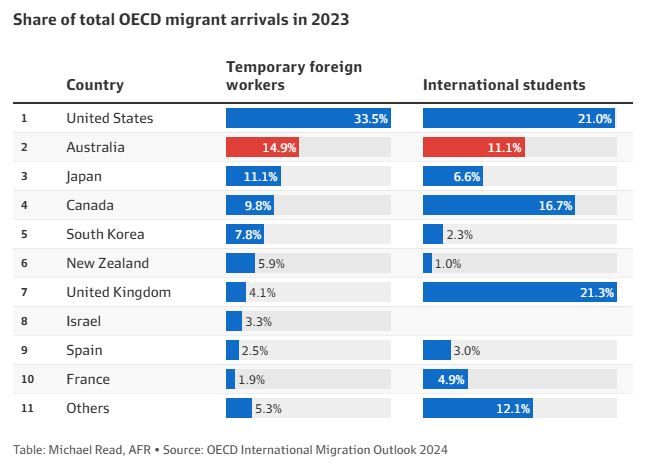
Given Australia’s demand-driven migration system and post-pandemic skills shortages, it has attracted a disproportionate share of recent global migration flows. The OECD estimates that almost one in two working holidaymakers globally in 2023 were in Australia.
The boom in backpackers and other temporary workers meant Australia welcomed 15 per cent of all temporary labour migrants across the OECD last year, despite representing just 1.9 per cent of the group’s population. Only the US admitted more foreign workers.
For foreign students, Australia was the fourth most popular country in 2023 behind the UK, the US and Canada, admitting 11 per cent of all migrants.
Regardless of the merits of migration, it is clear voters are unhappy about the pace of the intake after a record 541,452 people arrived last year. About 16 per cent of people surveyed by The Australian Financial Review/Freshwater Strategy poll in November nominated immigration as one of their top issues, up from just 5 per cent in September 2023.
While Labor pledged to cut net overseas migration to 260,000 this financial year, experts say that looks increasingly unattainable, despite a spate of policies over the past year designed to rein in the number of new students coming to Australia.
When living standards fall, so do governments. The Albanese government may hope Australia bucks the global trend, but as the polls loom, voters may trade the promise of better times ahead for the satisfaction of sending a message now.
