
Originally published by Matthew Denholm of The Australian
15.03.2026
The Albanese government has been accused of “serious negligence” and “putting the community at risk” by ignoring warnings on fuel and fertiliser vulnerabilities for years, as industry demanded an expedited food security plan.
Food industry groups and experts told The Australian the current fuel and fertiliser crisis, triggered by the Iran war, exposed government failure to heed repeated warnings on the need for a food and fuel security plan since 2022.
They urged the government to use the crisis – fuel shortages on farms and in regional areas, and surging fertiliser costs – as a catalyst to expedite, elevate and properly fund its promised national food security strategy.
“The lack of urgency and purpose can only be described as serious negligence on the government’s behalf, which is putting the Australian community at risk,” Food and Grocery Sector Forum industry chair Richard Forbes told The Australian.
“The government was warned four years ago on the consequences of not having an overarching, nationally co-ordinated food security plan. And here we are: no food security plan and no fuel security strategy, both of which must be part of Australia’s national security.”
Mr Forbes, also chief executive of Independent Food Distributors Australia, was one of nine key supply chain chiefs who wrote to the government in December 2022 pleading for an urgent food security plan to secure fuel and fertiliser inputs against external shocks.
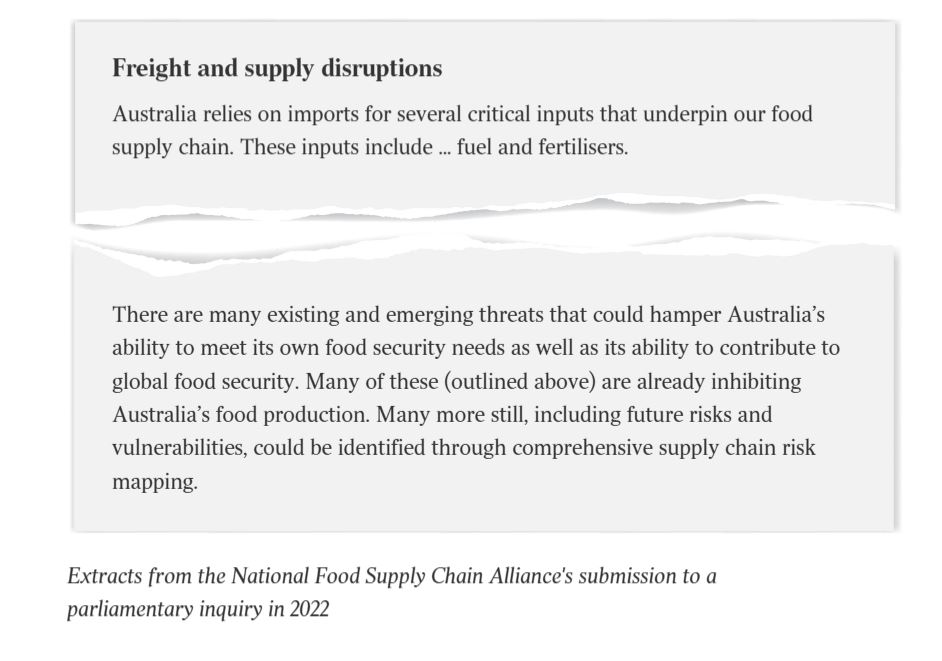
That submission – backed by further lobbying in 2023 and 2024, also seen by The Australian – warned the nation was vulnerable due to reliance on imports for “machinery and equipment … ingredients, crop protection products … fuel and fertilisers”.
“There are many existing and emerging threats that could hamper Australia’s ability to meet its own food security needs as well as its ability to contribute to global food security,” the nine groups warned in 2022, pleading for supply chain risk assessment and a comprehensive plan.
The government finally announced in March 2025 $3.5m to develop a national food security strategy, “Feeding Australia”. However, industries are frustrated at a two-year development time frame and extended consultation to placate what some regard as “fringe groups”.
These include small-scale farmers and food justice and nutrition advocates who, backed by the Macdoch Foundation, have run a “Who Decides Food?” campaign to broaden representation on the National Food Council, chosen to develop the strategy.
Peak food industry groups and experts are concerned the campaign will dilute the strategy and detract from the urgent need to secure critical inputs to food production and distribution.
National Food Council member Andrew Henderson, author of a landmark food security green paper, told The Australian that while broader issues were important, they must not divert focus from key inputs such as fuel and fertiliser.
“The basic function of our food system relies on it,” Mr Henderson said. “If we haven’t shored up those foundations, then we won’t be talking about food nutrition – we’ll be talking about basic food availability. And that goes to social cohesion and the stability of our society.
“We have to take a very calm and clear-eyed approach to preparing for these types of shocks – and that’s what the underlying ambition of a food security strategy needs to be.”
Mr Henderson said the current crisis demonstrated the strategy “should be one of the highest priorities of the Albanese government”.
“It has to be taken seriously by defence and national security agencies, and given the appropriate resources and imprimatur to ensure that it delivers for not just the food system and for agriculture but the national interest,” Mr Henderson said.
“If nothing else, this situation is demonstrating the fragility of our supply chains. As a society, we have not learned the lessons that Covid tried to teach us, and if we don’t learn them now then I’m afraid we’ll never learn.”
Mr Henderson backed calls by Mr Forbes and other industry figures for significant funding to drive delivery of the strategy.
“If we’re prepared to spend $368bn on AUKUS (nuclear submarines), then we should be prepared to spend the required resources necessary to address the vulnerabilities in Australia’s agriculture and food system,” he said. “You can’t eat nuclear-powered submarines.”
Mr Forbes called on the government, which announced on Friday it would release 20 per cent of Australia’s emergency fuel reserves, to commit $100m to an urgent plan “that identifies all potential disrupters to the food supply chain, starting with fuel”.
“We must become a nation that is more self-sufficient, which includes reducing the volume of inputs from overseas and focusing on increasing our domestic processing ability in areas like fuel and fertiliser,” he said.
GrainGrowers chief executive Shona Gawel said the current crisis “reinforces the urgent need for a strong and co-ordinated national food security strategy”.
This must include input sovereignty, supply chain resilience, protection of agricultural land, trade access, biosecurity, and climate adaptation, she said.
“A prime example is Australia’s reliance on imported fertiliser, including urea transported via the Strait of Hormuz, which is a critical input for grain production,” Ms Gawel said.
Agriculture Minister Julie Collins said the government had not been not ignoring the issues while awaiting development of the strategy.
“While the development of this strategy continues, we are investing in a Future Made in Australia, including $1.1bn to help produce more low-carbon liquid fuels here in Australia, and a $220m loan to Perdaman to build the largest urea plant in Australia,” Ms Collins said.
“The Albanese Labor government is working day and night with our farmers and producers to help manage the impacts of the conflict in the Middle East
“The national food security strategy … will build on frameworks already in place that help safeguard Australia’s food production. The importance of supply chain resilience, including the supply of fuel and fertiliser, is a key part.”
Macdoch Australia executive chairman Alasdair MacLeod said the “Who Decides Food?” campaign was a response to the food council being too narrowly focused on “agricultural industry strategy”.
“If we want to have a council that’s just going to make sure we have access to critical inputs and fuel, then fine, call it that – but that’s not a food strategy,” Mr MacLeod said.
Too narrow a focus risked ignoring the role regenerative agriculture could have on food security by reducing the need for imported fertilisers and chemicals.
“There’s a bunch of issues that we’ve got to deal with, particularly the growing health crisis because of access to unhealthy food, and that’s what other governments around the world have done,” he said.
